

The best time to visit Vietnam for a trip covering the north, central coast, and south is usually March to April. These months offer the most balanced conditions across the country: northern Vietnam is warming up, central Vietnam is generally sunny, and the south is still in its drier season.
There is no single perfect month for every destination, however. Vietnam stretches over a long distance, and its weather patterns differ sharply between the north, central coast and highlands, and south. A wet week in Hội An can coincide with clearer conditions in Hà Nội or Ho Chi Minh City, so it is better to plan around your route than look for one national dry season.
Vietnam weather at a glance
| Region | Usually best for | Least reliable period | What this means for travellers |
|---|---|---|---|
| Northern Vietnam Hà Nội, Ninh Bình, Hạ Long Bay, Sa Pa |
March to April, October to November | June to August for heat, humidity, and heavy rain | Expect proper seasonal variation, including cool and misty winter conditions in the mountains. |
| Central Vietnam Huế, Đà Nẵng, Hội An, Phong Nha |
February to April for the best balance; beach weather often extends into summer | September to January, particularly during stormy spells | This is the region to treat most carefully in autumn, when heavy rain and flooding can disrupt a tightly timed itinerary. |
| South-central coast and highlands Nha Trang, Đà Lạt |
Nha Trang: January to August Đà Lạt: November to March |
Nha Trang: September to December Đà Lạt: May to October |
These areas do not follow exactly the same pattern as Hội An and Huế, so they can be useful alternatives. |
| Southern Vietnam Ho Chi Minh City, Mekong Delta, Phú Quốc |
December to April | May to November | It stays hot year-round; the main difference is between drier sunshine and regular wet-season downpours. |
This broad pattern is reflected in the official Vietnam Tourism weather guide, but weather at mountain altitude, on the coast, and on islands can differ from the conditions in a nearby city.
Northern Vietnam: best in spring and autumn
Northern Vietnam has the country’s clearest seasonal contrast. Hà Nội, Ninh Bình, Hạ Long Bay, Sa Pa, and the northern mountain routes can feel unexpectedly cool between December and March. Hà Nội is often misty and overcast then, while higher areas such as Sa Pa can be genuinely cold, especially overnight.
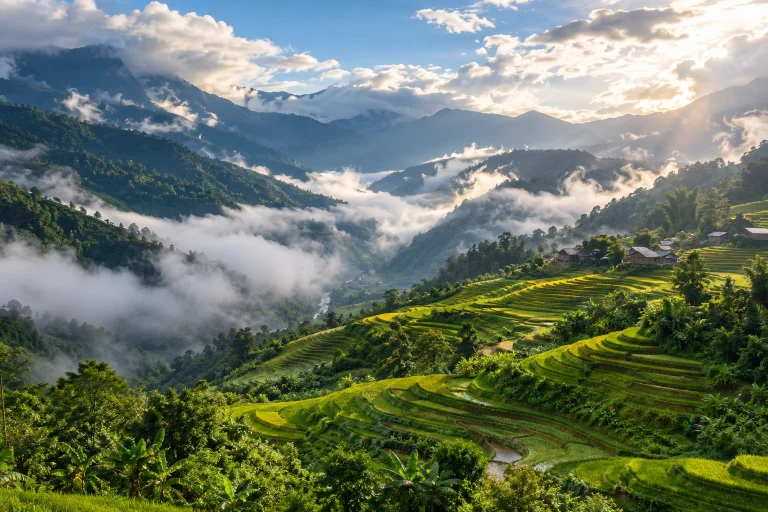
March and April are strong months for a northern itinerary if you want warmer sightseeing weather before the summer humidity becomes intense. October to November is another excellent window, particularly for city walks, countryside routes, and northern highland scenery. Early autumn can also be a useful time for rice terraces, although the exact appearance and harvest timing vary by valley and year.
From roughly June to August, expect hot, humid conditions and frequent rain. This does not make northern Vietnam off-limits, but it changes the trip: trekking trails can become muddy and slippery, mountain views may be obscured by cloud, and Hạ Long Bay cruises can be delayed or cancelled when storms affect the Gulf of Tonkin. Build flexibility into any cruise, trekking, or motorbike-based plans rather than placing them immediately before an international flight.
Central Vietnam: choose dates carefully in autumn
Central Vietnam has the most important weather trade-off for travellers planning a north-to-south route. Huế, Đà Nẵng, Hội An, and Phong Nha are commonly sunny and hot from around spring into summer, while their wetter period arrives later than it does in the north and south.
February to April is usually the easiest period for combining Hội An, Đà Nẵng, Huế, and inland sights without the fiercest summer heat or the main late-year rains. From May to August, the coast can suit beach-focused trips, but midday sightseeing can be demanding: heat, strong sun, and high temperatures are a real consideration around Huế and Hội An.
From September onwards, conditions become less dependable. September to January is generally the wetter period in Hội An, while Huế can remain wet into February. Tropical storms and prolonged rain can affect central Vietnam in the latter part of the year, and flooding is possible in low-lying areas, particularly around Hội An and Huế. If you are travelling in October or November, keep hotel and transport plans flexible, and check local forecasts before committing to boat trips, caves, beach days, or long road journeys.
Do not assume that all of central Vietnam has identical weather. Nha Trang is generally sunnier for more of the year, with its wetter period usually falling from September to December. Inland Đà Lạt is cooler because of its elevation, but its rainier season broadly runs from May to October, with conditions varying around the start and end of the season.
Southern Vietnam: driest from December to April
Ho Chi Minh City, the Mekong Delta, and much of southern Vietnam are hot throughout the year. The practical distinction is simple: December to April is generally the drier, sunnier period, while May to November brings more regular rainfall and humidity.
The wet season does not necessarily mean continuous rain. In Ho Chi Minh City and the Mekong Delta, downpours often arrive later in the day, leaving useful time for morning sightseeing. Even so, intense rain can slow road traffic, affect pavements, and make tightly scheduled city days less pleasant. Lightweight, quick-drying clothing, a small umbrella or rain jacket, and waterproof protection for phones and documents are sensible.
For a beach break in Phú Quốc, the most dependable period is generally the drier part of the year. The island’s wet and stormier conditions can make beaches less appealing and sea crossings less comfortable, especially in the middle of the rainy season. Check the forecast and your operator’s latest notices shortly before any ferry journey.
Which months work best for a multi-region Vietnam itinerary?
March and April: the best all-round choice
For most first-time, multi-stop trips, March and April are the most straightforward months. The north is usually more comfortable than in summer, central Vietnam is generally dry, and southern Vietnam remains in its dry season. The main compromise is heat: central and southern destinations can become very warm by April, so plan outdoor sightseeing early and leave the middle of the day for a slower lunch, museum, spa, or hotel break.
November: good for the north and south, less certain in the centre
November can work very well if your priorities are Hà Nội, Ninh Bình, Sa Pa, Ho Chi Minh City, the Mekong Delta, or Phú Quốc. Northern temperatures are more comfortable and the south is moving into its drier period. However, it is not the month to rely on for a weather-sensitive central coast holiday: Huế and Hội An can still see significant rain.
December to February: best for the south, cooler in the north
This period is a good fit for travellers prioritising southern beaches, Ho Chi Minh City, and the Mekong Delta. Northern Vietnam can be atmospheric but cool, grey, and misty, especially in the mountains and around Hạ Long Bay. Central Vietnam is variable: coastal destinations may improve later in the season, but Huế and Hội An should not be treated as guaranteed dry choices in January.
May to August: choose the centre for beaches, but expect heat
Summer can be a practical time for Đà Nẵng, Hội An, and other central-coast beach destinations if you can handle high temperatures. At the same time, the north and south become wetter and more humid. This is a reasonable season for travellers who can accept occasional changes of plan, but it is less suitable for a trip centred on cool-weather trekking, clear mountain views, or fixed cruise dates.
September and October: better for northern Vietnam than the central coast
These months can be rewarding for Hà Nội, Ninh Bình, Sa Pa, and the northern mountains, particularly from October as the worst summer heat and rain begin to ease. They are much less reliable for Huế, Đà Nẵng, and Hội An because of the central coast’s wetter, storm-prone season. Southern Vietnam remains warm and wet, although city and food-focused travel can still work well with flexible daily plans.
Choose your dates by trip style
- Beaches and island time: Choose December to April for Phú Quốc and southern Vietnam. For Đà Nẵng and Hội An beaches, February to August is generally more favourable, although the height of summer is hot.
- Trekking and mountain scenery: Aim for March to April or October to November in the north. Take warm layers from December to February, and allow for muddy trails and reduced views during the summer rains.
- Hạ Long Bay cruises: Spring and autumn are often useful windows, but sea conditions can change quickly. Avoid putting a cruise immediately before a flight or another non-refundable connection.
- City sightseeing: March, April, October, and November are generally easier than the peak heat and rain periods, although the best choice depends on the city.
- A whole-country itinerary: Prioritise March or April. If travelling in autumn, consider a route focused on the north and south rather than forcing central Vietnam into fixed dates.
What to pack for Vietnam’s changing climates
A Vietnam itinerary can require more varied clothing than travellers expect. For a north-to-south trip, pack breathable clothes for tropical heat, modest layers for temples and air-conditioned transport, a compact waterproof layer, and shoes that can cope with wet pavements or muddy paths. Add a fleece or lightweight insulated layer for northern Vietnam between December and March, particularly for Sa Pa, Hà Giang, or other mountain areas.
For beach and boat travel, sun protection matters as much as rain protection: bring high-SPF sunscreen, a hat, and a reusable water bottle. In the wetter months, keep a dry bag or waterproof pouch for electronics and travel documents.
The key point
If you want the best chance of comfortable weather across northern, central, and southern Vietnam in one trip, choose March or April. For a specific region, follow its own climate rather than Vietnam’s national seasons: visit the north in spring or autumn, the central coast mainly from February to August, and the south from December to April. Before travel, especially during the central-coast storm season or before a cruise or ferry, check the latest warnings from Vietnam’s National Center for Hydro-Meteorological Forecasting.

Comments