

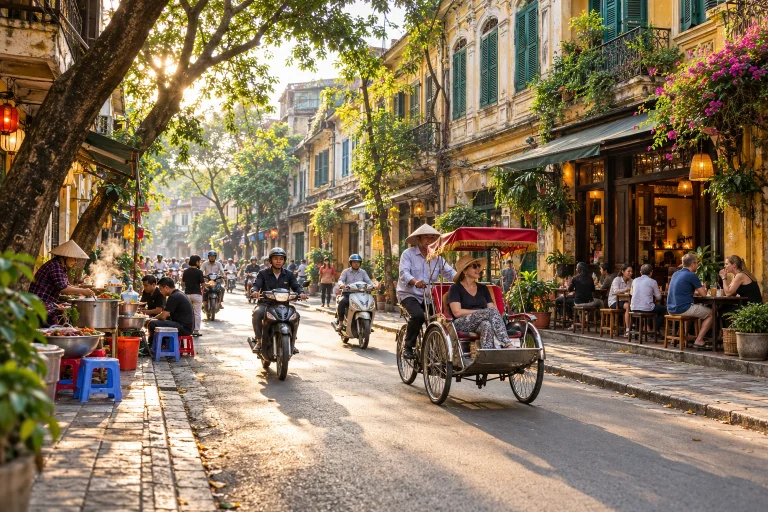
For a first visit, spend three full days in Hanoi. This gives you time for the Old Quarter and Hoan Kiem Lake, the city’s key historic sites, several proper food stops, and a slower afternoon around a café, museum, or West Lake. Two days works if Hanoi is the start or end of a wider Vietnam itinerary, while four days suits travellers who want to explore more museums, neighbourhoods, and local food without rushing.
Hanoi is best approached as a city to experience at street level. Its headline sights matter, but so do the small-scale details between them: pavement food stalls, narrow trading streets, lakeside walks, old shop houses, and the constant movement of motorbikes. Build your days around one or two main sights, then leave room to walk, eat, and stop when somewhere looks interesting.
How many days should you spend in Hanoi?
| Time in Hanoi | What it realistically allows |
|---|---|
| 1 night / 1 day | A quick Old Quarter walk, Hoan Kiem Lake, a meal, and perhaps one museum. Useful only when time is very limited. |
| 2 full days | The essential first visit: Old Quarter, Hoan Kiem, the Temple of Literature or Hoa Lo Prison, and the Ba Dinh sights. |
| 3 full days | The best balance for most visitors, with time for food, cafés, a quieter neighbourhood, and less rushed sightseeing. |
| 4 days or more | Good for museums, West Lake, shopping, food tours, and a more relaxed pace before or after travelling elsewhere in northern Vietnam. |
If you are following a wider route, Hanoi works particularly well as a two- or three-night starting point before heading to Ninh Binh, Ha Long Bay, Cat Ba, or the mountains in the north. For a realistic route through the country, see our Vietnam two-week itinerary.
The best things to do in Hanoi
Walk the Old Quarter and Hoan Kiem Lake
The Old Quarter is Hanoi at its busiest and most immediately memorable. Its dense grid of lanes is easy to explore without a fixed route, although it is worth using Hoan Kiem Lake as your reference point when you need to reorient yourself. Start early if you prefer quieter streets, then return in the evening when food stalls, cafés, and bars fill up.
Do not expect a polished heritage district. The appeal is the mixture of working streets, old buildings, small temples, shops, traffic, and food. The pace can be intense, particularly around Tạ Hiện and the streets that are pedestrianised at certain times, but a short walk east or south of the busiest lanes quickly changes the atmosphere.
Visit the Temple of Literature
The Temple of Literature is one of Hanoi’s most worthwhile historic stops, especially for visitors who want context beyond the Old Quarter. Founded as a Confucian temple and associated with Vietnam’s early scholarly tradition, it is a calm, courtyard-based complex that contrasts sharply with the surrounding traffic. Allow around 60 to 90 minutes, and combine it with a nearby museum or a walk towards Hanoi Railway Station rather than trying to fit it into an Old Quarter morning.
Plan the Ba Dinh sights for one morning
The Ho Chi Minh Mausoleum, Ba Dinh Square, the Presidential Palace area, Ho Chi Minh’s Stilt House, and One Pillar Pagoda are close enough to visit as one group. If seeing inside the mausoleum is important, plan this for an early morning and check the current opening days, seasonal closure dates, dress requirements, and security rules shortly before you go. Access is regulated, and the mausoleum does not operate like an all-day museum.
Dress respectfully for the mausoleum and religious sites, covering shoulders and knees. Even when the mausoleum itself is closed, the wider Ba Dinh area can still be worthwhile for its monuments, gardens, and historical setting.
Choose a museum that matches your interests
Hanoi’s museums are best chosen selectively rather than treated as a checklist. Hoa Lo Prison is a compact, powerful stop close to the French Quarter and Hoan Kiem area, examining the site’s colonial history and later use during the war. Check current hours and ticket information through the official Hoa Lo Prison relic site before setting out, particularly around public holidays.
The Vietnam Museum of Ethnology is a stronger choice if you want to understand the country’s ethnic diversity and traditional architecture, but it is farther west and deserves a separate half-day rather than being squeezed between central sights.
Spend an unplanned afternoon around West Lake or Truc Bach
West Lake is not a major sightseeing checklist destination; it is a useful change of pace from the Old Quarter. Go for a long walk, a coffee, or a meal, and combine it with Truc Bach if you prefer a smaller, more residential waterside setting. This area is especially useful after a busy day of central Hanoi sightseeing, but it is less convenient than the Old Quarter if your stay is very short.
Where to stay in Hanoi
For most first-time visitors, the Old Quarter or the north and west sides of Hoan Kiem Lake are the most convenient places to stay. You can walk to a wide range of restaurants, cafés, shops, tour offices, and central sights, and you will not need a car each time you go out in the evening.
The trade-off is noise, traffic, compact rooms, and sometimes difficult access for cars on narrow lanes. Budget hotels in older buildings can also have steep staircases, very small lifts, or windowless rooms, so check recent guest photographs and the exact room type before booking.
Choose the French Quarter or the southern and eastern side of Hoan Kiem Lake if you want a more spacious, calmer base with easier access to museums and the Opera House area. Ba Dinh and Truc Bach are better for travellers prioritising historic sights, broader streets, and a quieter central atmosphere. Our detailed guide to where to stay in Hanoi explains the practical differences between each area.
What to eat in Hanoi
Hanoi rewards travellers who eat at different times of day rather than searching for one definitive restaurant. Phở is an easy breakfast choice, while bún chả is traditionally most associated with lunch: grilled pork and patties served with rice noodles, herbs, and a light dipping broth. Other dishes worth looking for include chả cá, bánh cuốn, bún thang, and phở cuốn around Truc Bach.
Egg coffee is a Hanoi classic, but it is richer and sweeter than an everyday coffee. Try it once as a dessert-like stop, then also order a simple Vietnamese black coffee or coffee with condensed milk to understand the city’s everyday café culture.
For street food, choose stalls that are busy with a steady local turnover, with food cooked to order where possible. Pointing, photos, and translation apps are usually enough for simple ordering. Carry small notes, ask the price before ordering if it is not displayed, and be clear about any allergies or dietary requirements; fish sauce, pork, shellfish, and peanuts are common ingredients.
Getting around Hanoi without wasting time
Central Hanoi is walkable in sections, but not as one continuous pedestrian city. Walk within the Old Quarter, around Hoan Kiem Lake, and between nearby sights, then use a taxi or ride-hailing car for longer journeys. App-based rides are particularly useful when the heat, rain, luggage, or traffic makes walking less appealing. Check the vehicle registration and driver details in the app before getting in.
Crossing streets can feel daunting at first. The safest approach is usually to wait for a reasonable gap, move steadily and predictably, and avoid sudden backward steps. Motorbike riders are accustomed to moving around pedestrians; sudden changes of direction make this harder. Use marked crossings and pedestrian lights where available, but remain alert, as traffic behaviour may not match what you are used to at home.
Hanoi’s metro is useful for specific cross-city journeys, rather than as the main way to see the tourist centre. Line 2A runs between Cát Linh and Yên Nghĩa, while Line 3 has operated in stages and its available section may change as construction progresses. Check the official Hanoi Metro website for current station, ticket, and operating information. For most first visits, walking and ride-hailing are simpler.
Arriving from Noi Bai Airport
Noi Bai International Airport is north of central Hanoi, so allow extra time after landing for immigration, baggage, and city traffic. A pre-booked hotel transfer, official airport taxi, or app-based car is easiest if you have a late arrival, children, heavy bags, or accommodation deep in the Old Quarter.
For a lower-cost daytime option, Airport Bus 86 connects the airport with Hanoi Railway Station, with stops useful for the Old Quarter area. Fares, routes, and operating hours can change, so check the airport’s current transport information before travelling. For step-by-step arrival advice, including avoiding unsolicited drivers, read our guide to getting from Hanoi Airport to the Old Quarter.
When to visit Hanoi
Hanoi has four distinct seasons. Autumn, broadly September to November, is often the easiest time for sightseeing, with cooler and generally drier conditions. Spring can be pleasant, although late winter and early spring may bring cool temperatures, mist, and drizzle. Summer is hot, humid, and prone to heavy rain, while winter can feel surprisingly chilly indoors because many budget rooms have limited heating.
Weather matters more here than it does in many compact city breaks. Pack a light waterproof layer at any time of year, breathable clothing for warmer months, and an extra layer for evenings between December and February. In high summer, plan outdoor sights early, take a longer lunch break, and keep afternoons flexible around storms.
The key point
Hanoi is most rewarding when you give it three full days and avoid trying to see everything at speed. Base yourself near the Old Quarter or Hoan Kiem Lake, group the Ba Dinh sights into one morning, walk widely but use ride-hailing for longer journeys, and treat meals and coffee stops as part of the itinerary rather than an afterthought. The city can be noisy, humid, and chaotic at first, but its best experiences are usually found by slowing down between the major sights.
Comments