

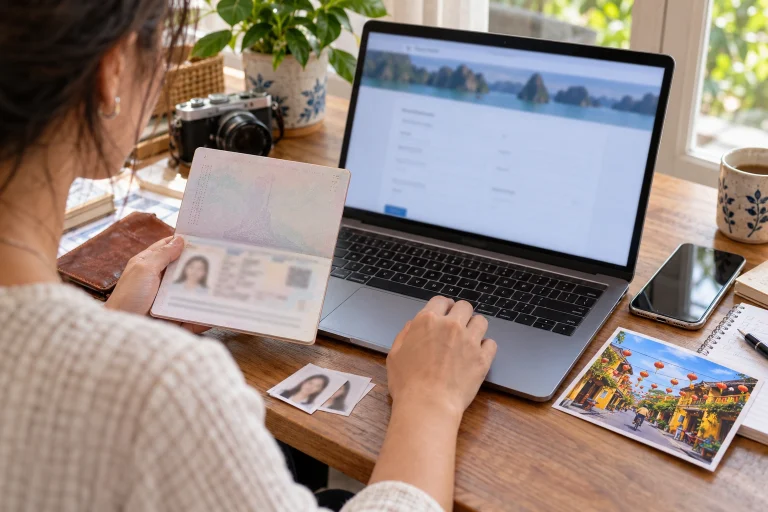
Most travellers who need a visa for Vietnam can apply online for a Vietnam e-Visa before travelling. An e-Visa may be issued for up to 90 days, for either one entry or multiple entries. Apply while outside Vietnam, use an approved international entry point, and make sure every passport detail matches your travel document exactly.
Visa rules, fees, approved border gates, and online procedures can change. Make your final application through the official Vietnam e-Visa portal, rather than a commercial visa website.
Do you need a Vietnam e-Visa?
Vietnam’s e-Visa system is available to citizens of all countries and territories, subject to immigration conditions and the type of passport or travel document held. However, you may not need an e-Visa if your nationality qualifies for visa-free entry and your trip fits within the permitted stay.
Vietnam has unilateral and bilateral visa-exemption arrangements, with conditions that vary by nationality, passport type, purpose of travel, and length of stay. Check the Vietnamese Ministry of Foreign Affairs visa-exemption list and the official e-Visa portal for the current position for your passport.
| Option | When it may suit you | Important point |
|---|---|---|
| Visa-free entry | Your passport is exempt and your trip is within the permitted stay | Rules depend on nationality and passport type |
| Single-entry e-Visa | You will enter Vietnam once before leaving | It cannot be used to re-enter after departure |
| Multiple-entry e-Visa | You will leave Vietnam and return during the visa validity period | Check the current fee and validity conditions on the official portal |
An e-Visa can be valid for a maximum of 90 days. This does not mean every applicant will automatically receive 90 days: request dates that match your itinerary, and do not arrive before the visa’s stated start date.
What you need before applying
Prepare the following before opening the form:
- A passport with sufficient validity for entry. Vietnam generally requires at least six months’ validity from arrival, but confirm current requirements with the official portal and your airline.
- A clear image of the passport data page.
- A recent portrait photograph that meets the portal’s image requirements.
- Your intended arrival and departure dates.
- Your intended first entry point, such as Nội Bài International Airport in Hanoi, Tân Sơn Nhất International Airport in Ho Chi Minh City, or Mộc Bài land border gate.
- An email address you can access throughout the application process.
- A payment card that works with the portal’s online payment system.
Follow the current photo, file-format, and file-size instructions shown in the application system. Images must be clear enough for passport details and facial features to be read reliably.
How to apply for a Vietnam e-Visa
- Use the official portal. Start at evisa.gov.vn. Do not assume that a search advert or agency website is the government application service.
- Select the correct visa type and dates. Choose single or multiple entry, then enter the dates you need. A multiple-entry e-Visa may be useful if, for example, you plan to visit Cambodia or Laos and return to Vietnam during the same visa period.
- Upload your passport page and portrait. Check that the passport image is complete, sharp, upright, and free from reflections or cropped edges.
- Enter personal details exactly as shown in your passport. Check your full name, date of birth, nationality, passport number, issue date, and expiry date carefully.
- Choose your intended entry checkpoint. Select the airport, land border, or seaport you expect to use, and check the latest official guidance if your plans change.
- Review before payment. Take time over this stage, as e-Visa fees are generally non-refundable, including when an application is refused or details have been entered incorrectly.
- Save the registration code. You will need it to check the result and download an approved e-Visa.
- Download and print the approved e-Visa. Carry a printed copy with your passport, as well as a saved copy on your phone.
The official portal commonly indicates processing of around three working days after a complete application and payment, but this is not a guaranteed deadline. Apply well before a flight or land-border journey, particularly around Vietnamese public holidays or fixed transport bookings.
Choosing the right entry point
An e-Visa may only be used at international border gates approved for e-Visa entry and exit. Vietnam’s approved airports, land crossings, and seaports can change, so check the current list in the official e-Visa portal before applying and again shortly before departure.
Choose the entry point that matches your ticket or transport plan. This is particularly important for overland journeys, where a bus route may use a different crossing from the one you expected.
Travellers entering from Cambodia should check the precise crossing used by their transport operator. Mộc Bài is the Vietnam-side checkpoint on the main Phnom Penh–Ho Chi Minh City overland route. For practical planning, see our Bavet–Mộc Bài border crossing guide. Other Cambodia–Vietnam routes, including Tịnh Biên, Hà Tiên, Vĩnh Xương, and Xa Mát, suit different onward itineraries. Our guide to Cambodia–Vietnam border crossings explains the main route options.
If your itinerary changes after you apply, do not assume that the selected entry point can be ignored. Check the latest guidance in the official portal or use its support route before travelling, especially if changing from an airport arrival to a land-border crossing.
Common Vietnam e-Visa mistakes to avoid
Applying through an unofficial website by accident
Many commercial services use names and page designs that resemble an official application site, then add service charges. An agency can be useful in limited circumstances, but it is not required for a straightforward application. The government portal uses the evisa.gov.vn domain.
Entering a name differently from the passport
Do not shorten names, omit middle names, or alter the order or spelling of names from the passport data page. A mismatch between the application, e-Visa, passport, and airline booking can cause problems at check-in or immigration.
Using a poor-quality passport scan
Dark images, glare across the data page, cropped machine-readable lines, and unclear characters can prevent an application from being processed. Use a flat, well-lit image, and check it at full size before uploading.
Choosing single entry when you need multiple entry
A single-entry e-Visa cannot be used again after you leave Vietnam. If you plan to visit Cambodia, Laos, or another country and then return to Vietnam, apply for multiple entry from the outset.
Booking travel for the day the visa is expected
Do not schedule a non-refundable flight, bus, or border crossing on the assumption that an e-Visa will arrive exactly three working days after payment. Allow a buffer, and travel only once the approved document has been downloaded and checked.
Forgetting that the visa has fixed dates
The permitted entry and exit dates appear on the approved e-Visa. You cannot enter before the start date, and you should not overstay the end date. Count your itinerary carefully, including late-night flights and overland journeys that may cross the border after midnight.
What to check after approval
Before travelling, compare the downloaded e-Visa with your passport and itinerary. Check your name, passport number, nationality, date of birth, entry type, validity dates, and intended entry point. Print it, keep it accessible during your journey, and carry the same passport used for the application.
Shortly before departure, recheck your airline’s requirements, your airport or land-border transport arrangements, and any current immigration instructions published through official Vietnamese sources.
The key point
For most visitors who are not visa-exempt, Vietnam’s e-Visa is a straightforward online application. Apply through the official portal while outside Vietnam, request the right dates and entry type, confirm that your arrival point is approved, and print the approval before travelling. The most avoidable problems are incorrect passport details, last-minute applications, and an entry plan that does not match the approved e-Visa or actual route.
Comments