

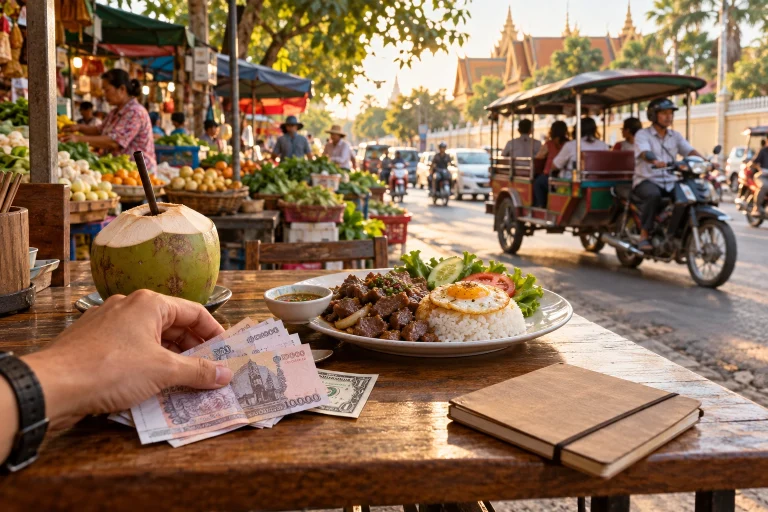
A realistic Cambodia travel budget is usually around US$35–55 per person per day for backpackers, US$70–130 for a mid-range trip, and US$160+ for a more comfortable holiday, excluding international flights. Your final spend depends most on accommodation style, how often you move between destinations, alcohol and nightlife, private transport, and whether you include Angkor, island time, or organised tours.
Cambodia can still offer good value, particularly for local food, guesthouses, and overland transport. However, do not plan on an ultra-low daily budget if you want private rooms, air conditioning, frequent Western meals, or several paid activities. Koh Rong and Koh Rong Samloem can also cost more than mainland destinations because supplies arrive by boat.
Quick Cambodia budget guide
These are practical planning ranges for independent travellers. They include accommodation, meals, ordinary local transport, drinks, and some incidental spending, but not international flights, travel insurance, visa costs, major attraction tickets, or every long-distance journey.
| Travel style | Typical daily budget | What this usually covers |
|---|---|---|
| Backpacker | US$35–55 | Dorm bed or simple room, Khmer food and casual cafés, shared buses, tuk-tuks, and a modest activity budget |
| Mid-range | US$70–130 | Comfortable private room, a mix of local and international restaurants, regular tuk-tuks, and selected tours or activities |
| Comfort-oriented | US$160+ | Higher-end hotels or resorts, private transfers, restaurant dining, cocktails, spa treatments, and guided experiences |
For couples sharing a room, the mid-range and comfort figures can be lower per person than for solo travellers. Travelling during peak holiday periods, booking late, or choosing beach resorts can move accommodation costs well above these ranges.
Accommodation: the biggest variable in your budget
Accommodation is where Cambodia offers the widest choice. In Phnom Penh, Siem Reap, Kampot, and Battambang, a dorm bed or very simple guesthouse room may be available from around US$8–20 per night. Budget private rooms commonly begin around US$15–35, although quality, location, air conditioning, and breakfast make a noticeable difference.
For a reliable mid-range hotel room, budget roughly US$40–90 per night. In popular areas and at busy times, well-reviewed boutique hotels can cost more. Comfortable resorts, international-standard hotels, pool villas, and higher-end island stays can start around US$100 per night and rise substantially during high-demand dates.
Island accommodation needs separate planning. Koh Rong and Koh Rong Samloem have options for backpackers and travellers seeking a quieter resort stay, but availability is more limited than in Cambodia’s main cities. Book earlier for weekends, public holidays, Christmas, New Year, and the driest months. Choosing your beach carefully can also affect how much you spend on meals and local boat transfers. Our Koh Rong hotel guide and Koh Rong Samloem hotel guide can help narrow down the right area before you book.
Food and drink costs in Cambodia
Eating local food is one of the easiest ways to keep a Cambodia travel budget under control. Simple Khmer meals, noodle soups, rice dishes, market snacks, and fresh fruit are often available for around US$2–5. Casual restaurants and traveller-focused cafés are more commonly US$5–10 per main meal.
Allow more for Western food, speciality coffee, hotel restaurants, imported wine, cocktails, and dining at beach resorts. A dinner at a good international or upscale Khmer restaurant can cost US$10–25 per person before drinks, and considerably more at top-end venues.
A useful middle-ground budget is US$15–25 per day for food if you mostly eat Khmer dishes and casual restaurant meals, or US$30–50+ if you prefer frequent café breakfasts, Western food, alcoholic drinks, and restaurant dinners.
Local and long-distance transport
Short journeys by tuk-tuk are usually inexpensive, but costs add up if you use them several times each day or rely on private cars. Agree the fare before setting off where a meter is not used, and consider walking when the heat, traffic, and distance make it sensible.
For travel between destinations, shared minivans and coaches are generally the most budget-friendly option. A common intercity journey may cost roughly US$8–18, depending on the route, operator, comfort level, and booking date. Private cars are more convenient for families, groups, or awkward arrival times, but naturally cost far more than a shared service.
Cambodia’s railway can be a low-cost option on selected routes. Timetables, fares, and availability can change, so check directly with Royal Railway before planning around a train service.
For an itinerary that includes the islands, allow separately for the Sihanoukville ferry. Fares vary by operator, destination beach, ticket type, and promotion. Ferry timings, departure piers, weather conditions, and destination beaches can change, so check the details close to travel in our Phnom Penh to Koh Rong transport guide, and confirm your exact hotel pier with the ferry company.
Activities and entrance fees
Some of Cambodia’s best experiences cost little beyond transport: walking Phnom Penh’s riverside, exploring local markets, relaxing on the islands, visiting smaller temples, and spending time in Kampot or Kep. Larger sights and organised activities need their own budget line.
The main example is Angkor. Angkor Archaeological Park pass prices and purchase arrangements should be checked through the official Angkor Enterprise website before travelling. Remember that transport around the temple complex, a guide, food, and sunrise starts are additional costs.
Elsewhere, allow roughly US$10–30 for a straightforward group activity, boat trip, cooking class, or guided outing, although specialist diving, private tours, multi-day treks, and premium excursions cost more. On Koh Rong and Koh Rong Samloem, factor in snorkelling trips, boat transfers, or dive activities if these are central to your stay rather than assuming beach time will be your only expense.
What a two-week Cambodia trip might cost
For a 14-night independent itinerary covering Phnom Penh, Siem Reap, Kampot or Kep, Sihanoukville, and Koh Rong or Koh Rong Samloem, a sensible starting point is:
| Travel style | Two-week on-the-ground budget | Best for |
|---|---|---|
| Backpacker | US$650–1,000 | Dorms or simple rooms, local meals, shared transport, and a few paid activities |
| Mid-range | US$1,250–2,100 | Private rooms, more restaurant meals, comfortable transport, Angkor, and island time |
| Comfort-oriented | US$2,500+ | Better hotels and resorts, private transfers, guided days out, and more flexible dining |
These totals are broad planning estimates that allow for domestic transport and selected paid sights or activities, but exclude international flights. Increase them if you plan domestic flights, diving, private drivers, premium hotels, extensive nightlife, or shopping. For route ideas that reduce unnecessary backtracking, see our Cambodia two-week itinerary.
Cash, cards, and contingency money
Build a small buffer into your Cambodia budget. ATMs are widely available in cities and larger towns, and cards work at many hotels, restaurants, and larger businesses, but cash remains important for markets, tuk-tuks, small eateries, and more remote locations.
The Cambodian riel is the national currency, while US dollars are widely used for many visitor transactions. Carry clean, undamaged dollar notes if you use cash, keep some riel for small purchases and change, and check ATM fees before confirming a withdrawal. Read our guide to Cambodian currency for practical details.
Do not arrive on Koh Rong or Koh Rong Samloem assuming cash access will be as straightforward as it is in Phnom Penh or Siem Reap. Card terminals, cash-out services, and connectivity can be limited or temporarily unavailable, so bring enough cash for accommodation balances, meals, activities, and an emergency margin. See our guide to accessing cash on Koh Rong before travelling.
The key point
Cambodia can suit a wide range of budgets, but a realistic trip is not just about finding the cheapest bed or meal. Budget separately for long-distance journeys, Angkor passes, island ferries, and activities, then keep a 10–15% contingency for changing plans and cash-only expenses. For most independent travellers who want private accommodation and a varied itinerary, US$70–130 per person per day is a practical starting point before international flights.


Comments